Posterior Distribution of the Standardized Direct Effect Centrality Over a Specific Time Interval or a Range of Time Intervals
Source:R/cTMed-posterior-direct-central-std.R
PosteriorDirectCentralStd.RdThis function generates a posterior distribution of the standardized direct effect centrality over a specific time interval \(\Delta t\) or a range of time intervals using the posterior distribution of the first-order stochastic differential equation model drift matrix \(\boldsymbol{\Phi}\) and process noise covariance matrix \(\boldsymbol{\Sigma}\).
Arguments
- phi
List of numeric matrices. Each element of the list is a sample from the posterior distribution of the drift matrix (\(\boldsymbol{\Phi}\)). Each matrix should have row and column names pertaining to the variables in the system.
- sigma
List of numeric matrices. Each element is a posterior draw of the diffusion covariance matrix.
- delta_t
Numeric. Time interval (\(\Delta t\)).
- ncores
Positive integer. Number of cores to use. If
ncores = NULL, use a single core. Consider using multiple cores when number of replicationsRis a large value.- tol
Numeric. Smallest possible time interval to allow.
Value
Returns an object
of class ctmedmc which is a list with the following elements:
- call
Function call.
- args
Function arguments.
- fun
Function used ("PosteriorDirectCentralStd").
- output
A list of length
length(delta_t).
Each element in the output list has the following elements:
- est
Mean of the posterior distribution of the standardized direct effect centrality.
- thetahatstar
Posterior distribution of the standardized direct effect centrality measure.
Details
See DirectCentralStd() for more details.
References
Bollen, K. A. (1987). Total, direct, and indirect effects in structural equation models. Sociological Methodology, 17, 37. doi:10.2307/271028
Deboeck, P. R., & Preacher, K. J. (2015). No need to be discrete: A method for continuous time mediation analysis. Structural Equation Modeling: A Multidisciplinary Journal, 23 (1), 61-75. doi:10.1080/10705511.2014.973960
Pesigan, I. J. A., Russell, M. A., & Chow, S.-M. (2025). Inferences and effect sizes for direct, indirect, and total effects in continuous-time mediation models. Psychological Methods. doi:10.1037/met0000779
Ryan, O., & Hamaker, E. L. (2021). Time to intervene: A continuous-time approach to network analysis and centrality. Psychometrika, 87 (1), 214-252. doi:10.1007/s11336-021-09767-0
See also
Other Continuous-Time Mediation Functions:
BootBeta(),
BootBetaStd(),
BootDirectCentral(),
BootDirectCentralStd(),
BootIndirectCentral(),
BootIndirectCentralStd(),
BootMed(),
BootMedStd(),
BootTotalCentral(),
BootTotalCentralStd(),
DeltaBeta(),
DeltaBetaStd(),
DeltaDirectCentral(),
DeltaDirectCentralStd(),
DeltaIndirectCentral(),
DeltaMed(),
DeltaMedStd(),
DeltaTotalCentral(),
DeltaTotalCentralStd(),
Direct(),
DirectCentral(),
DirectCentralStd(),
DirectStd(),
Indirect(),
IndirectCentral(),
IndirectCentralStd(),
IndirectStd(),
MCBeta(),
MCBetaStd(),
MCDirectCentral(),
MCDirectCentralStd(),
MCIndirectCentral(),
MCIndirectCentralStd(),
MCMed(),
MCMedStd(),
MCPhi(),
MCPhiSigma(),
MCTotalCentral(),
MCTotalCentralStd(),
Med(),
MedStd(),
PosteriorBeta(),
PosteriorBetaStd(),
PosteriorDirectCentral(),
PosteriorIndirectCentral(),
PosteriorIndirectCentralStd(),
PosteriorMed(),
PosteriorMedStd(),
PosteriorTotalCentral(),
PosteriorTotalCentralStd(),
Total(),
TotalCentral(),
TotalCentralStd(),
TotalStd(),
Trajectory()
Examples
set.seed(42)
phi <- matrix(
  data = c(
    -0.357, 0.771, -0.450,
    0.000, -0.511, 0.729,
    0.000, 0.000, -0.693
  ),
  nrow = 3
)
colnames(phi) <- rownames(phi) <- c("x", "m", "y")

sigma <- matrix(
  data = c(
    0.24455556, 0.02201587, -0.05004762,
    0.02201587, 0.07067800, 0.01539456,
    -0.05004762, 0.01539456, 0.07553061
  ),
  nrow = 3
)
colnames(sigma) <- rownames(sigma) <- c("x", "m", "y")

input <- MCPhiSigma(
  phi = phi,
  sigma = sigma,
  vcov_theta = 0.001 * diag(15),
  R = 100L,
  seed = 42
)$output

phi <- lapply(
  X = input,
  FUN = function(x) {
    x[[1]]
  }
)

sigma <- lapply(
  X = input,
  FUN = function(x) {
    x[[2]]
  }
)

# Specific time interval ----------------------------------------------------
PosteriorDirectCentralStd(
  phi = phi,
  sigma = sigma,
  delta_t = 1
)
#> Call:
#> PosteriorDirectCentralStd(phi = phi, sigma = sigma, delta_t = 1)
#>
#> Direct Effect Centrality
#>   variable interval     est     se   R    2.5%   97.5%
#> 1        x        1  0.5575 0.0420 100  0.4731  0.6458
#> 2        m        1 -0.2868 0.0508 100 -0.4038 -0.1999
#> 3        y        1  0.3897 0.0323 100  0.3248  0.4410

# Range of time intervals ---------------------------------------------------
posterior <- PosteriorDirectCentralStd(
  phi = phi,
  sigma = sigma,
  delta_t = 1:5
)

# Methods -------------------------------------------------------------------
# PosteriorDirectCentralStd has a number of methods including
# print, summary, confint, and plot
print(posterior)
#> Call:
#> PosteriorDirectCentralStd(phi = phi, sigma = sigma, delta_t = 1:5)
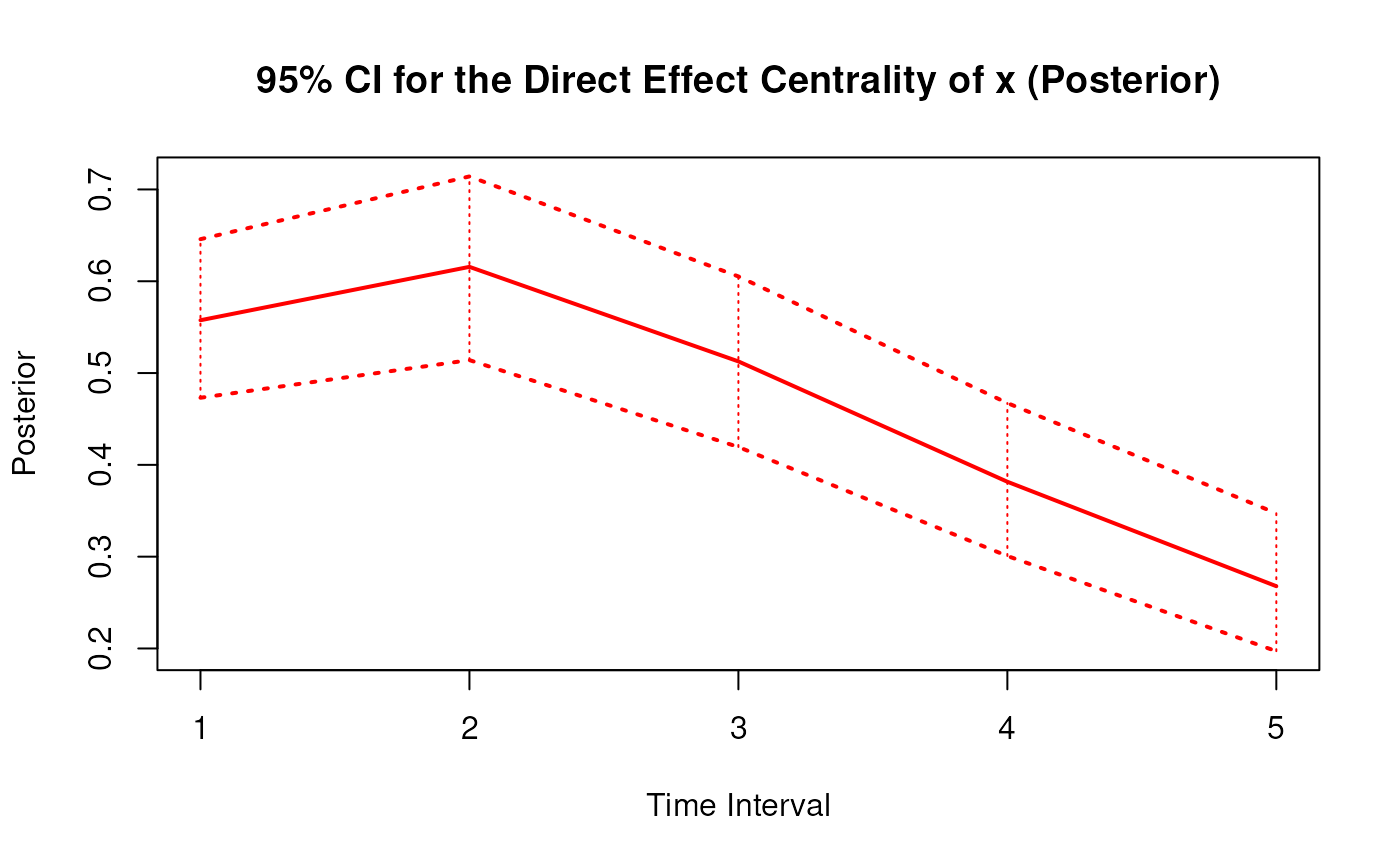
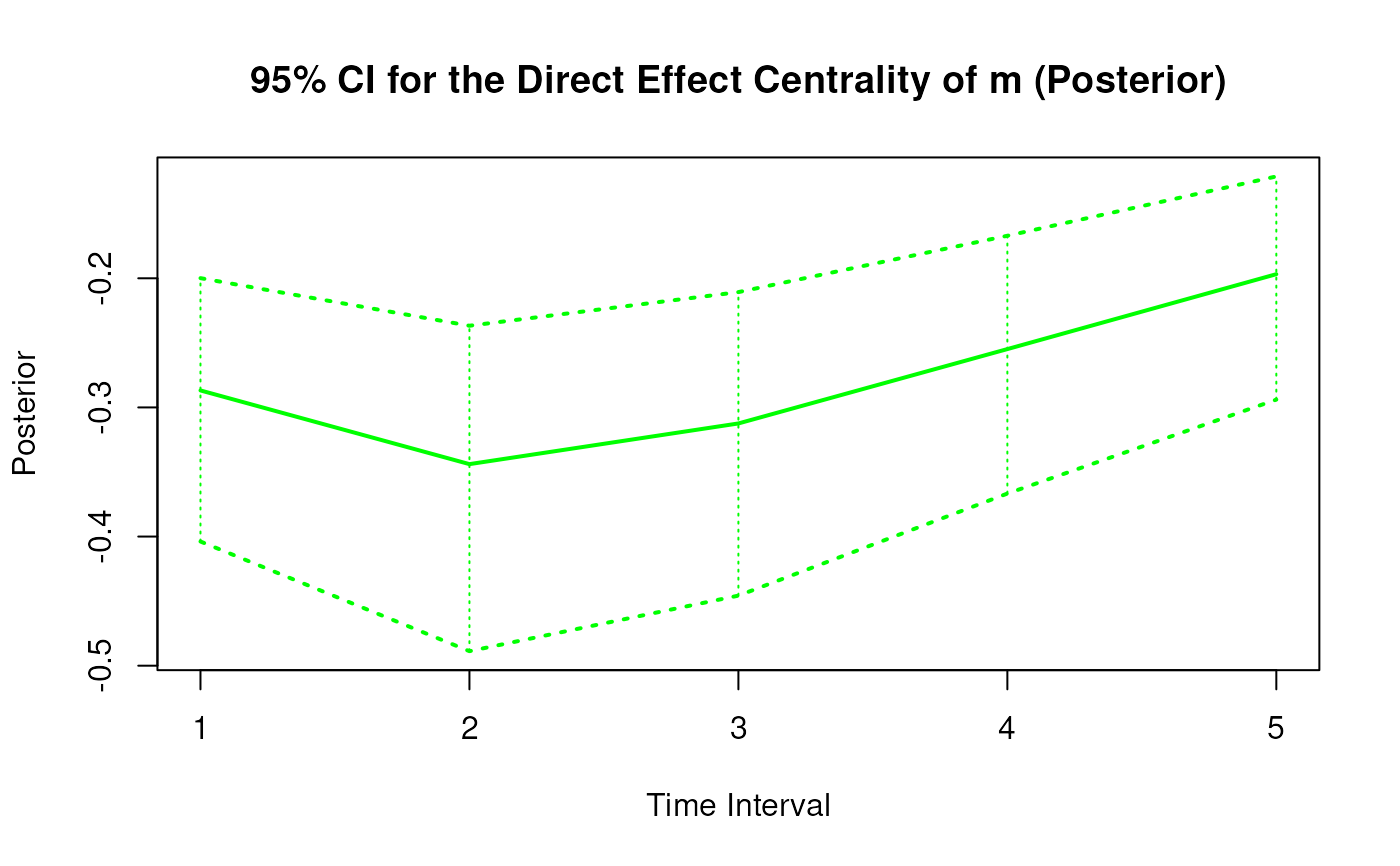
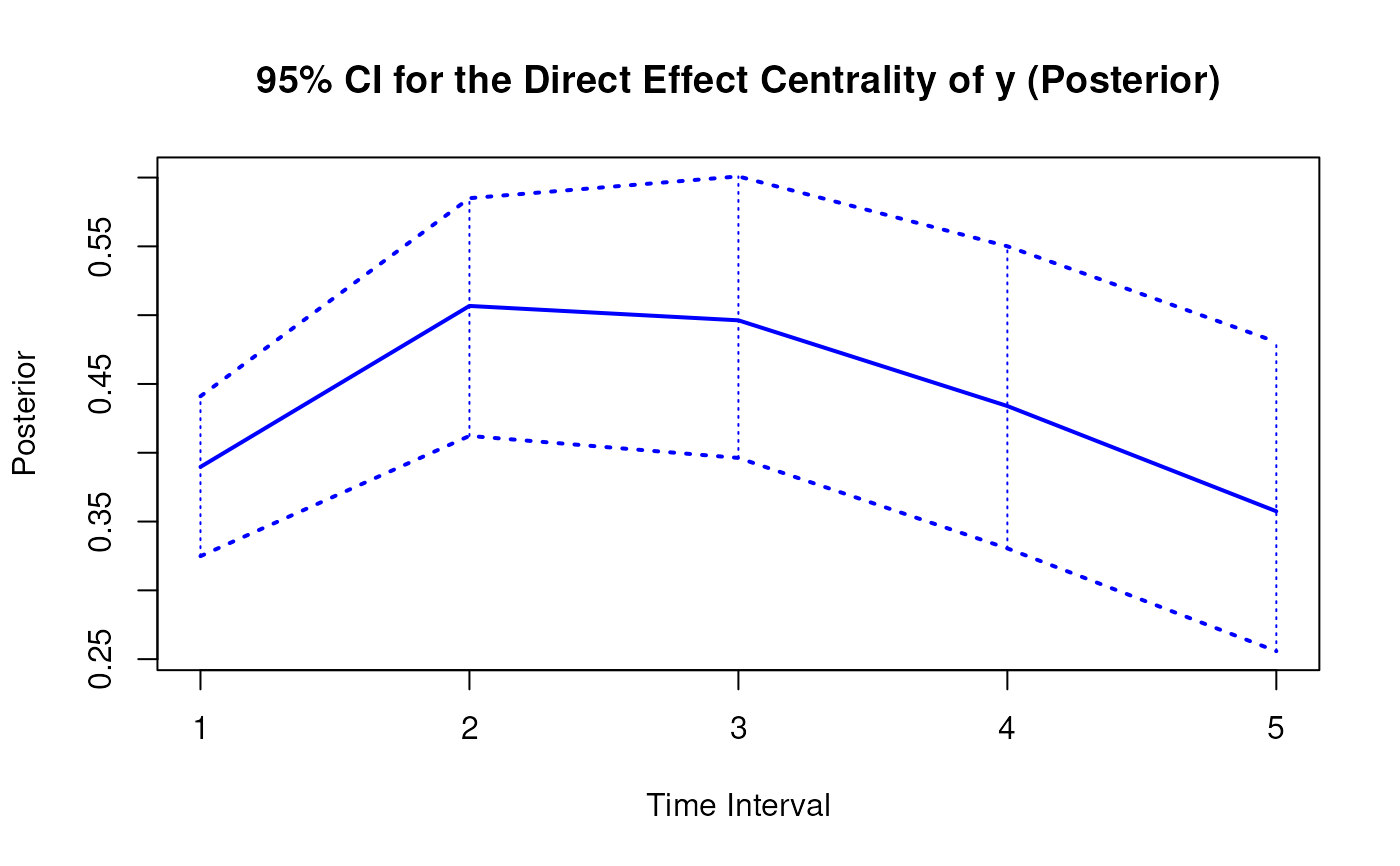
#>
#> Direct Effect Centrality
#>    variable interval     est     se   R    2.5%   97.5%
#> 1         x        1  0.5575 0.0420 100  0.4731  0.6458
#> 2         m        1 -0.2868 0.0508 100 -0.4038 -0.1999
#> 3         y        1  0.3897 0.0323 100  0.3248  0.4410
#> 4         x        2  0.6157 0.0491 100  0.5141  0.7142
#> 5         m        2 -0.3439 0.0644 100 -0.4888 -0.2367
#> 6         y        2  0.5067 0.0452 100  0.4122  0.5850
#> 7         x        3  0.5127 0.0479 100  0.4195  0.6052
#> 8         m        3 -0.3124 0.0636 100 -0.4457 -0.2107
#> 9         y        3  0.4963 0.0529 100  0.3962  0.6008
#> 10        x        4  0.3816 0.0445 100  0.3007  0.4673
#> 11        m        4 -0.2548 0.0576 100 -0.3667 -0.1671
#> 12        y        4  0.4340 0.0579 100  0.3305  0.5501
#> 13        x        5  0.2678 0.0397 100  0.1971  0.3473
#> 14        m        5 -0.1968 0.0502 100 -0.2940 -0.1211
#> 15        y        5  0.3575 0.0602 100  0.2558  0.4806
summary(posterior)
#> Call:
#> PosteriorDirectCentralStd(phi = phi, sigma = sigma, delta_t = 1:5)
#>
#> Direct Effect Centrality
#>    variable interval     est     se   R    2.5%   97.5%
#> 1         x        1  0.5575 0.0420 100  0.4731  0.6458
#> 2         m        1 -0.2868 0.0508 100 -0.4038 -0.1999
#> 3         y        1  0.3897 0.0323 100  0.3248  0.4410
#> 4         x        2  0.6157 0.0491 100  0.5141  0.7142
#> 5         m        2 -0.3439 0.0644 100 -0.4888 -0.2367
#> 6         y        2  0.5067 0.0452 100  0.4122  0.5850
#> 7         x        3  0.5127 0.0479 100  0.4195  0.6052
#> 8         m        3 -0.3124 0.0636 100 -0.4457 -0.2107
#> 9         y        3  0.4963 0.0529 100  0.3962  0.6008
#> 10        x        4  0.3816 0.0445 100  0.3007  0.4673
#> 11        m        4 -0.2548 0.0576 100 -0.3667 -0.1671
#> 12        y        4  0.4340 0.0579 100  0.3305  0.5501
#> 13        x        5  0.2678 0.0397 100  0.1971  0.3473
#> 14        m        5 -0.1968 0.0502 100 -0.2940 -0.1211
#> 15        y        5  0.3575 0.0602 100  0.2558  0.4806
confint(posterior, level = 0.95)
#>    variable interval      2.5 %     97.5 %
#> 1         x        1  0.4730964  0.6458223
#> 2         m        1 -0.4038379 -0.1998902
#> 3         y        1  0.3248434  0.4410491
#> 4         x        2  0.5141040  0.7141747
#> 5         m        2 -0.4887537 -0.2367458
#> 6         y        2  0.4122335  0.5850121
#> 7         x        3  0.4194614  0.6052307
#> 8         m        3 -0.4457488 -0.2107098
#> 9         y        3  0.3962477  0.6008256
#> 10        x        4  0.3007393  0.4673146
#> 11        m        4 -0.3667067 -0.1670797
#> 12        y        4  0.3304900  0.5500645
#> 13        x        5  0.1970597  0.3472963
#> 14        m        5 -0.2939719 -0.1211268
#> 15        y        5  0.2557957  0.4805656
plot(posterior)