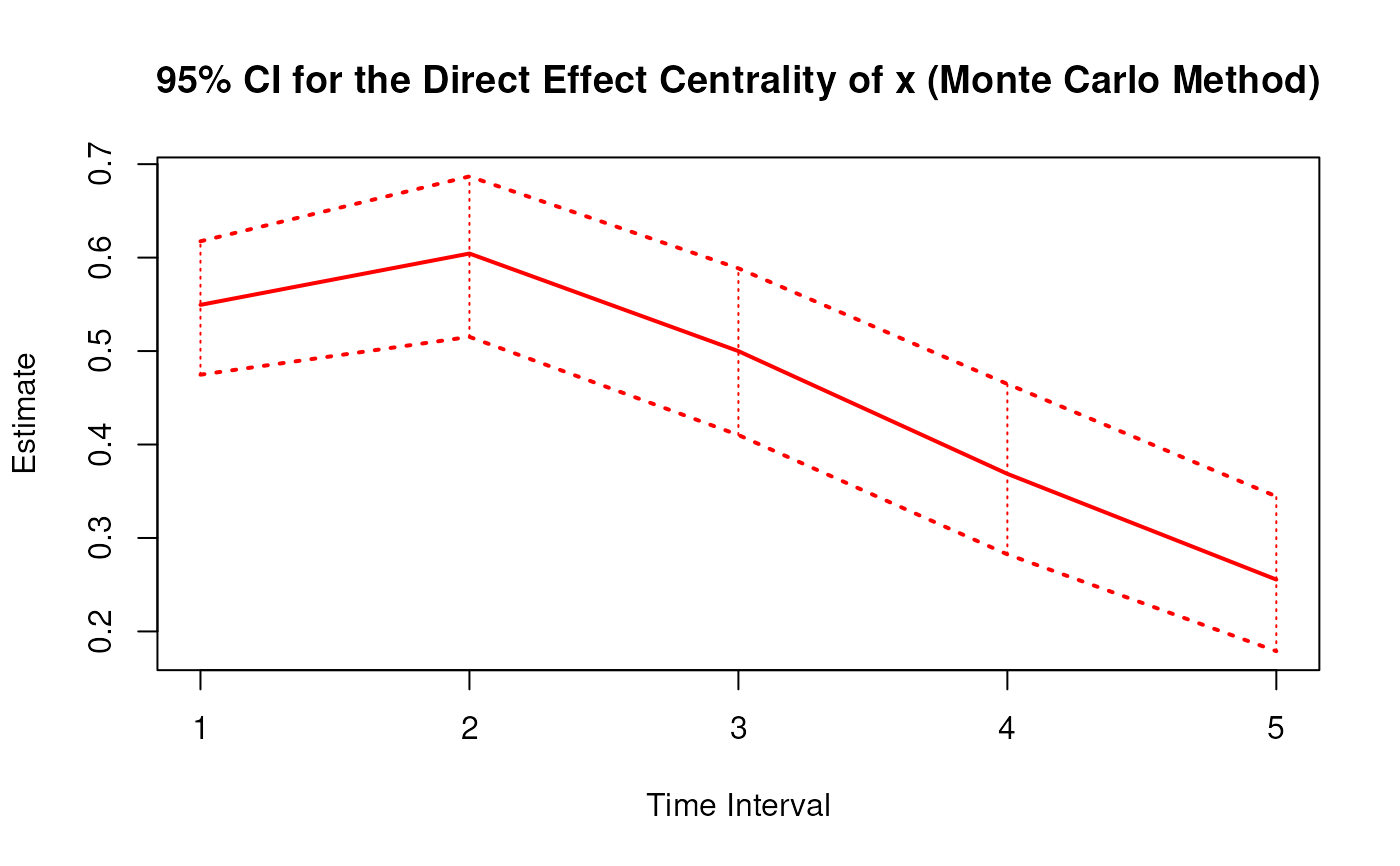
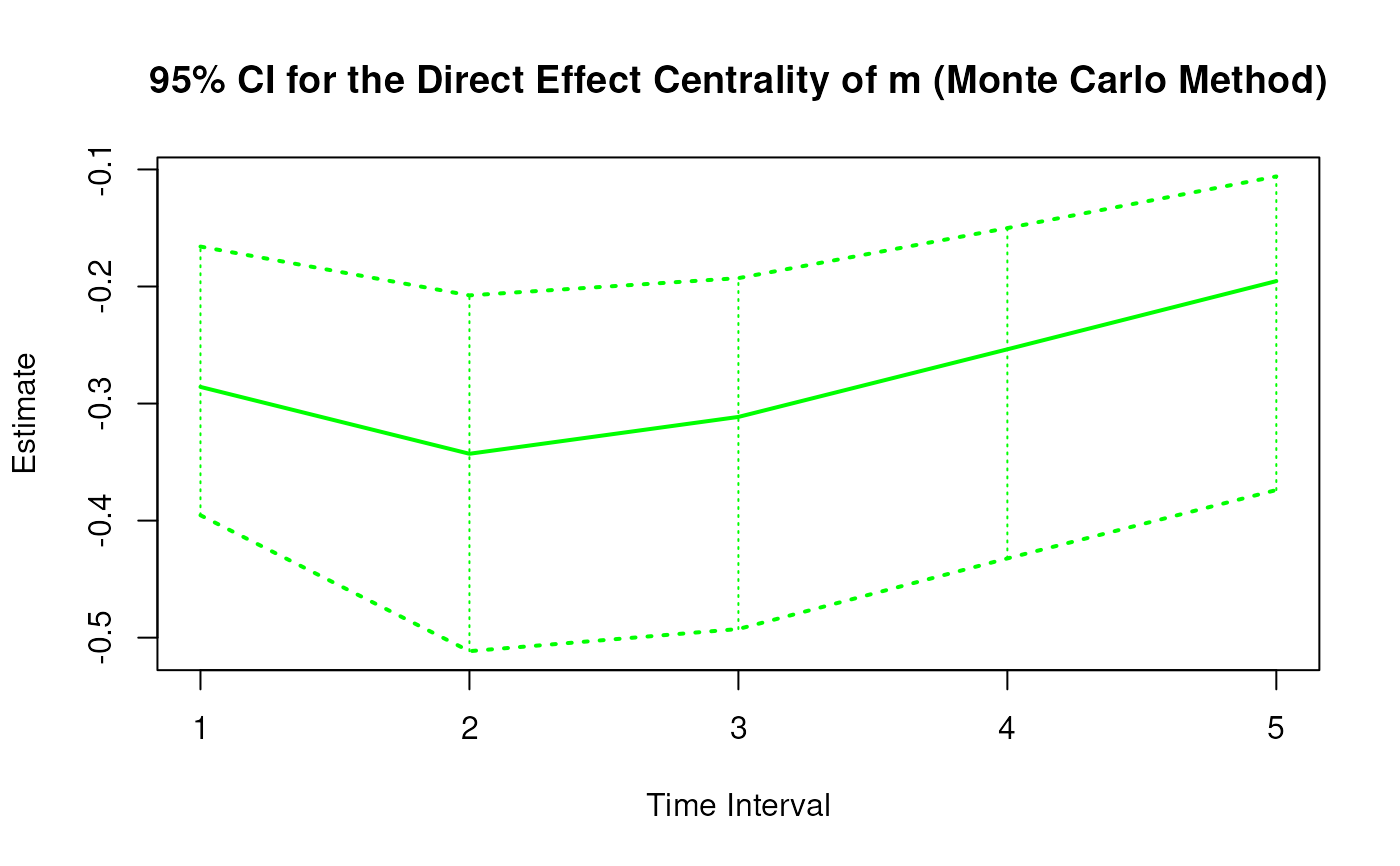
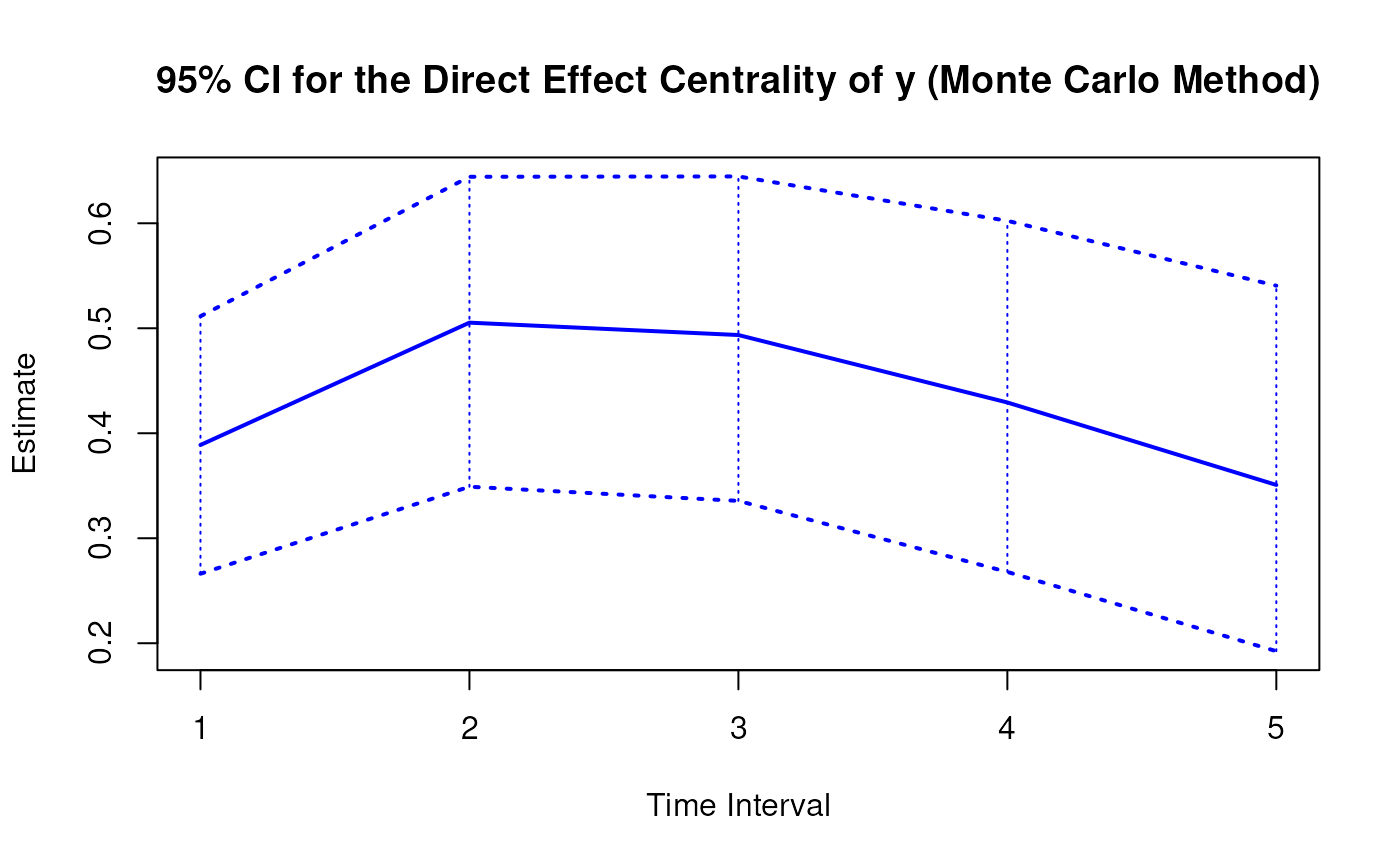
Monte Carlo Sampling Distribution of Standardized Direct Effect Centrality Over a Specific Time Interval or a Range of Time Intervals
Source:R/cTMed-mc-direct-central-std.R
MCDirectCentralStd.RdThis function generates a Monte Carlo method sampling distribution of the standardized direct effect centrality at a particular time interval \(\Delta t\) using the first-order stochastic differential equation model drift matrix \(\boldsymbol{\Phi}\) and process noise covariance matrix \(\boldsymbol{\Sigma}\).
Usage
MCDirectCentralStd(
  phi,
  sigma,
  vcov_theta,
  delta_t,
  R,
  test_phi = TRUE,
  sigma_diag = FALSE,
  ncores = NULL,
  seed = NULL,
  tol = 0.001
)
Arguments
- phi
Numeric matrix. The drift matrix (\(\boldsymbol{\Phi}\)).
phishould have row and column names pertaining to the variables in the system.- sigma
Numeric matrix. The process noise covariance matrix (\(\boldsymbol{\Sigma}\)).
- vcov_theta
Numeric matrix. The sampling variance-covariance matrix of \(\mathrm{vec} \left( \boldsymbol{\Phi} \right)\) and \(\mathrm{vech} \left( \boldsymbol{\Sigma} \right)\)
- delta_t
Numeric. Time interval (\(\Delta t\)).
- R
Positive integer. Number of replications.
- test_phi
Logical. If
test_phi = TRUE, the function tests the stability of the generated drift matrix \(\boldsymbol{\Phi}\). If the test returnsFALSE, the function generates a new drift matrix \(\boldsymbol{\Phi}\) and runs the test recursively until the test returnsTRUE.- sigma_diag
Logical. If
sigma_diag = TRUE, treat \(\boldsymbol{\Sigma}\) as a diagonal matrix.- ncores
Positive integer. Number of cores to use. If
ncores = NULL, use a single core. Consider using multiple cores when number of replicationsRis a large value.- seed
Random seed.
- tol
Numeric. Smallest possible time interval to allow.
Value
Returns an object
of class ctmedmc which is a list with the following elements:
- call
Function call.
- args
Function arguments.
- fun
Function used ("MCDirectCentralStd").
- output
A list of length
length(delta_t).
Each element in the output list has the following elements:
- est
A vector of standardized direct effect centrality.
- thetahatstar
A matrix of Monte Carlo standardized direct effect centrality.
Details
See DirectCentralStd() for more details.
Monte Carlo Method
Let \(\boldsymbol{\theta}\) be a vector that combines \(\mathrm{vec} \left( \boldsymbol{\Phi} \right)\), that is, the elements of the \(\boldsymbol{\Phi}\) matrix in vector form sorted column-wise and \(\mathrm{vech} \left( \boldsymbol{\Sigma} \right)\), that is, the unique elements of the \(\boldsymbol{\Sigma}\) matrix in vector form sorted column-wise. Let \(\hat{\boldsymbol{\theta}}\) be a vector that combines \(\mathrm{vec} \left( \hat{\boldsymbol{\Phi}} \right)\) and \(\mathrm{vech} \left( \hat{\boldsymbol{\Sigma}} \right)\). Based on the asymptotic properties of maximum likelihood estimators, we can assume that estimators are normally distributed around the population parameters. $$ \hat{\boldsymbol{\theta}} \sim \mathcal{N} \left( \boldsymbol{\theta}, \mathbb{V} \left( \hat{\boldsymbol{\theta}} \right) \right) $$ Using this distributional assumption, a sampling distribution of \(\hat{\boldsymbol{\theta}}\) which we refer to as \(\hat{\boldsymbol{\theta}}^{\ast}\) can be generated by replacing the population parameters with sample estimates, that is, $$ \hat{\boldsymbol{\theta}}^{\ast} \sim \mathcal{N} \left( \hat{\boldsymbol{\theta}}, \hat{\mathbb{V}} \left( \hat{\boldsymbol{\theta}} \right) \right) . $$ Let \(\mathbf{g} \left( \hat{\boldsymbol{\theta}} \right)\) be a parameter that is a function of the estimated parameters. A sampling distribution of \(\mathbf{g} \left( \hat{\boldsymbol{\theta}} \right)\) , which we refer to as \(\mathbf{g} \left( \hat{\boldsymbol{\theta}}^{\ast} \right)\) , can be generated by using the simulated estimates to calculate \(\mathbf{g}\). The standard deviations of the simulated estimates are the standard errors. Percentiles corresponding to \(100 \left( 1 - \alpha \right) \%\) are the confidence intervals.
References
Bollen, K. A. (1987). Total, direct, and indirect effects in structural equation models. Sociological Methodology, 17, 37. doi:10.2307/271028
Deboeck, P. R., & Preacher, K. J. (2015). No need to be discrete: A method for continuous time mediation analysis. Structural Equation Modeling: A Multidisciplinary Journal, 23 (1), 61-75. doi:10.1080/10705511.2014.973960
Pesigan, I. J. A., Russell, M. A., & Chow, S.-M. (2025). Inferences and effect sizes for direct, indirect, and total effects in continuous-time mediation models. Psychological Methods. doi:10.1037/met0000779
Ryan, O., & Hamaker, E. L. (2021). Time to intervene: A continuous-time approach to network analysis and centrality. Psychometrika, 87 (1), 214-252. doi:10.1007/s11336-021-09767-0
See also
Other Continuous-Time Mediation Functions:
BootBeta(),
BootBetaStd(),
BootDirectCentral(),
BootDirectCentralStd(),
BootIndirectCentral(),
BootIndirectCentralStd(),
BootMed(),
BootMedStd(),
BootTotalCentral(),
BootTotalCentralStd(),
DeltaBeta(),
DeltaBetaStd(),
DeltaDirectCentral(),
DeltaDirectCentralStd(),
DeltaIndirectCentral(),
DeltaMed(),
DeltaMedStd(),
DeltaTotalCentral(),
DeltaTotalCentralStd(),
Direct(),
DirectCentral(),
DirectCentralStd(),
DirectStd(),
Indirect(),
IndirectCentral(),
IndirectCentralStd(),
IndirectStd(),
MCBeta(),
MCBetaStd(),
MCDirectCentral(),
MCIndirectCentral(),
MCIndirectCentralStd(),
MCMed(),
MCMedStd(),
MCPhi(),
MCPhiSigma(),
MCTotalCentral(),
MCTotalCentralStd(),
Med(),
MedStd(),
PosteriorBeta(),
PosteriorBetaStd(),
PosteriorDirectCentral(),
PosteriorDirectCentralStd(),
PosteriorIndirectCentral(),
PosteriorIndirectCentralStd(),
PosteriorMed(),
PosteriorMedStd(),
PosteriorTotalCentral(),
PosteriorTotalCentralStd(),
Total(),
TotalCentral(),
TotalCentralStd(),
TotalStd(),
Trajectory()
Examples
phi <- matrix(
data = c(
-0.357, 0.771, -0.450,
0.0, -0.511, 0.729,
0, 0, -0.693
),
nrow = 3
)
colnames(phi) <- rownames(phi) <- c("x", "m", "y")
sigma <- matrix(
data = c(
0.24455556, 0.02201587, -0.05004762,
0.02201587, 0.07067800, 0.01539456,
-0.05004762, 0.01539456, 0.07553061
),
nrow = 3
)
vcov_theta <- matrix(
data = c(
0.00843, 0.00040, -0.00151, -0.00600, -0.00033,
0.00110, 0.00324, 0.00020, -0.00061, -0.00115,
0.00011, 0.00015, 0.00001, -0.00002, -0.00001,
0.00040, 0.00374, 0.00016, -0.00022, -0.00273,
-0.00016, 0.00009, 0.00150, 0.00012, -0.00010,
-0.00026, 0.00002, 0.00012, 0.00004, -0.00001,
-0.00151, 0.00016, 0.00389, 0.00103, -0.00007,
-0.00283, -0.00050, 0.00000, 0.00156, 0.00021,
-0.00005, -0.00031, 0.00001, 0.00007, 0.00006,
-0.00600, -0.00022, 0.00103, 0.00644, 0.00031,
-0.00119, -0.00374, -0.00021, 0.00070, 0.00064,
-0.00015, -0.00005, 0.00000, 0.00003, -0.00001,
-0.00033, -0.00273, -0.00007, 0.00031, 0.00287,
0.00013, -0.00014, -0.00170, -0.00012, 0.00006,
0.00014, -0.00001, -0.00015, 0.00000, 0.00001,
0.00110, -0.00016, -0.00283, -0.00119, 0.00013,
0.00297, 0.00063, -0.00004, -0.00177, -0.00013,
0.00005, 0.00017, -0.00002, -0.00008, 0.00001,
0.00324, 0.00009, -0.00050, -0.00374, -0.00014,
0.00063, 0.00495, 0.00024, -0.00093, -0.00020,
0.00006, -0.00010, 0.00000, -0.00001, 0.00004,
0.00020, 0.00150, 0.00000, -0.00021, -0.00170,
-0.00004, 0.00024, 0.00214, 0.00012, -0.00002,
-0.00004, 0.00000, 0.00006, -0.00005, -0.00001,
-0.00061, 0.00012, 0.00156, 0.00070, -0.00012,
-0.00177, -0.00093, 0.00012, 0.00223, 0.00004,
-0.00002, -0.00003, 0.00001, 0.00003, -0.00013,
-0.00115, -0.00010, 0.00021, 0.00064, 0.00006,
-0.00013, -0.00020, -0.00002, 0.00004, 0.00057,
0.00001, -0.00009, 0.00000, 0.00000, 0.00001,
0.00011, -0.00026, -0.00005, -0.00015, 0.00014,
0.00005, 0.00006, -0.00004, -0.00002, 0.00001,
0.00012, 0.00001, 0.00000, -0.00002, 0.00000,
0.00015, 0.00002, -0.00031, -0.00005, -0.00001,
0.00017, -0.00010, 0.00000, -0.00003, -0.00009,
0.00001, 0.00014, 0.00000, 0.00000, -0.00005,
0.00001, 0.00012, 0.00001, 0.00000, -0.00015,
-0.00002, 0.00000, 0.00006, 0.00001, 0.00000,
0.00000, 0.00000, 0.00010, 0.00001, 0.00000,
-0.00002, 0.00004, 0.00007, 0.00003, 0.00000,
-0.00008, -0.00001, -0.00005, 0.00003, 0.00000,
-0.00002, 0.00000, 0.00001, 0.00005, 0.00001,
-0.00001, -0.00001, 0.00006, -0.00001, 0.00001,
0.00001, 0.00004, -0.00001, -0.00013, 0.00001,
0.00000, -0.00005, 0.00000, 0.00001, 0.00012
),
nrow = 15
)
# Specific time interval ----------------------------------------------------
MCDirectCentralStd(
phi = phi,
sigma = sigma,
vcov_theta = vcov_theta,
delta_t = 1,
R = 100L # use a large value for R in actual research
)
#> Call:
#> MCDirectCentralStd(phi = phi, sigma = sigma, vcov_theta = vcov_theta,
#> delta_t = 1, R = 100L)
#>
#> Direct Effect Centrality
#> variable interval est se R 2.5% 97.5%
#> 1 x 1 0.5494 0.0373 100 0.4769 0.6287
#> 2 m 1 -0.2858 0.0567 100 -0.3855 -0.1583
#> 3 y 1 0.3888 0.0538 100 0.3004 0.5011
# Range of time intervals ---------------------------------------------------
mc <- MCDirectCentralStd(
phi = phi,
sigma = sigma,
vcov_theta = vcov_theta,
delta_t = 1:5,
R = 100L # use a large value for R in actual research
)
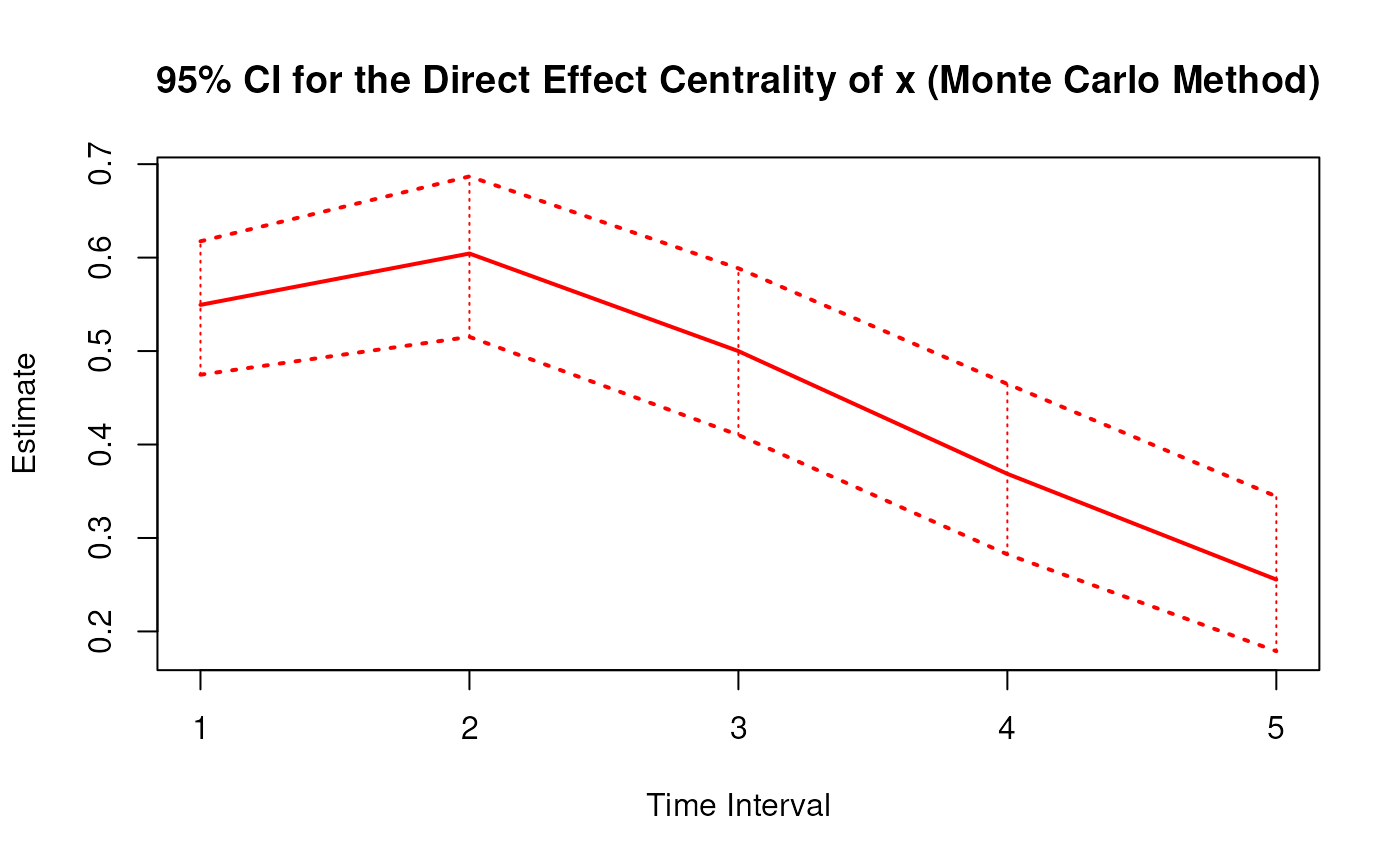
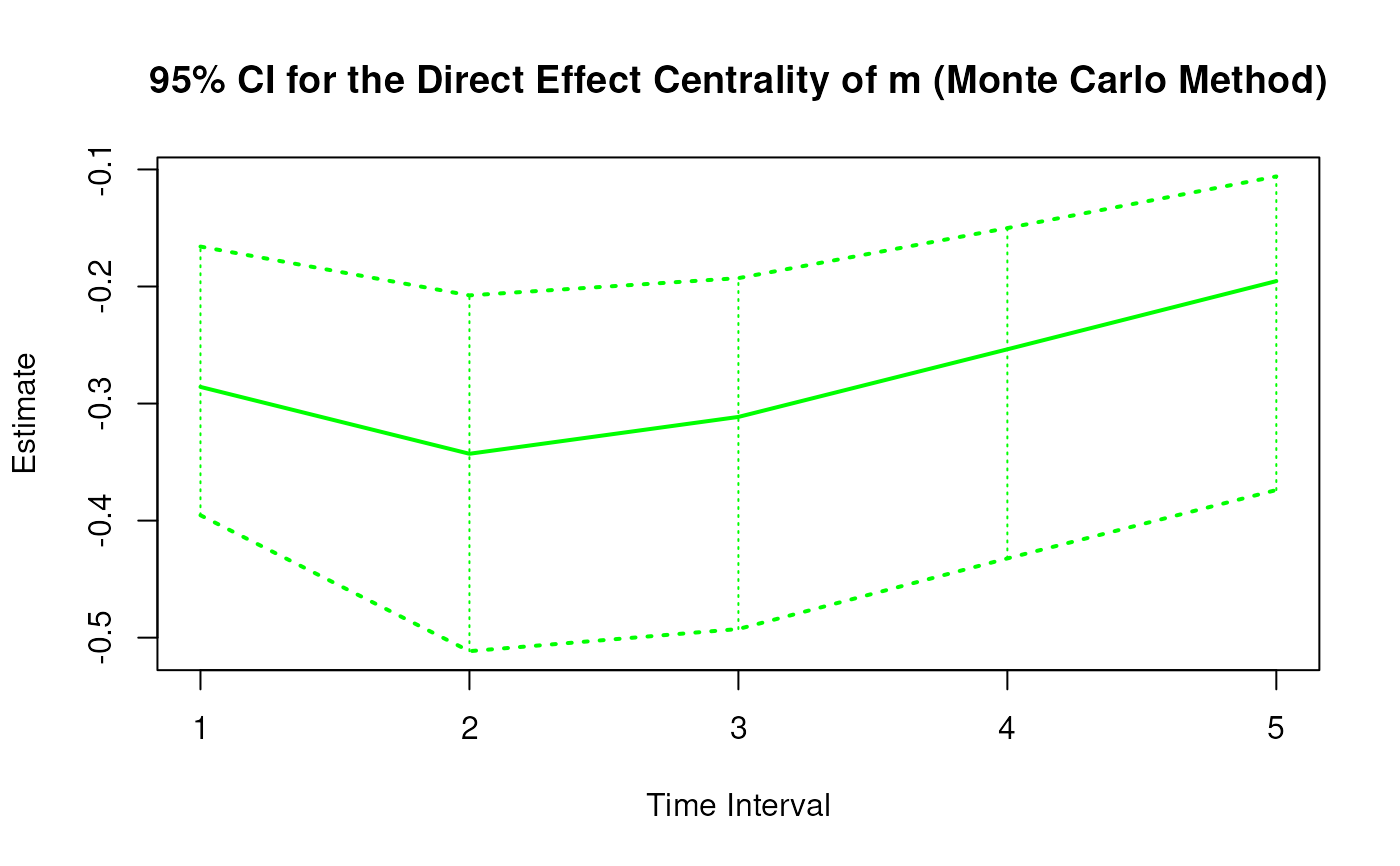
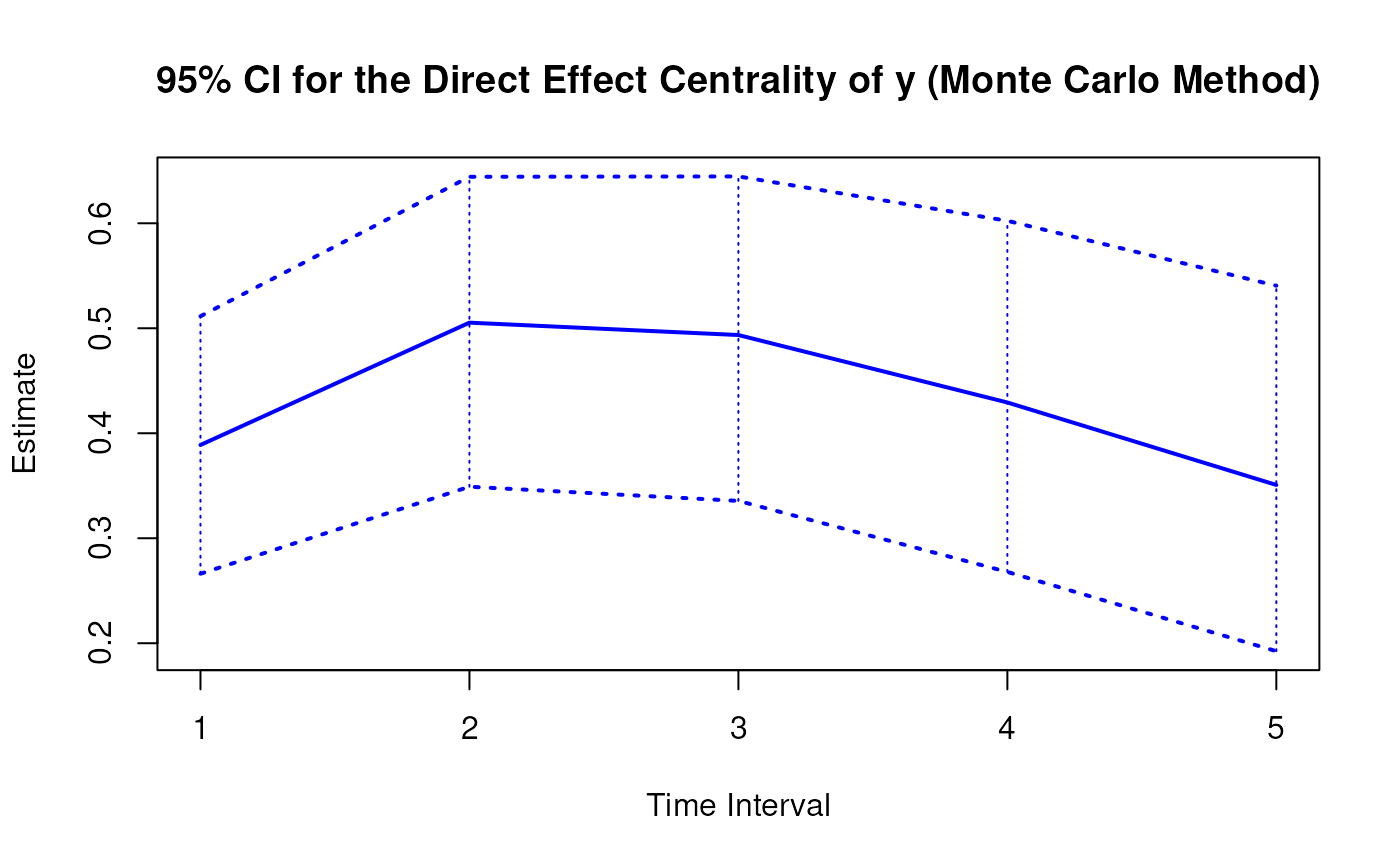
plot(mc)
 # Methods -------------------------------------------------------------------
# MCDirectCentralStd has a number of methods including
# print, summary, confint, and plot
print(mc)
#> Call:
#> MCDirectCentralStd(phi = phi, sigma = sigma, vcov_theta = vcov_theta,
#> delta_t = 1:5, R = 100L)
#>
#> Direct Effect Centrality
#> variable interval est se R 2.5% 97.5%
#> 1 x 1 0.5494 0.0370 100 0.4747 0.6175
#> 2 m 1 -0.2858 0.0552 100 -0.3954 -0.1659
#> 3 y 1 0.3888 0.0608 100 0.2662 0.5115
#> 4 x 2 0.6044 0.0416 100 0.5152 0.6869
#> 5 m 2 -0.3429 0.0708 100 -0.5115 -0.2076
#> 6 y 2 0.5053 0.0738 100 0.3491 0.6443
#> 7 x 3 0.4999 0.0441 100 0.4102 0.5885
#> 8 m 3 -0.3114 0.0741 100 -0.4926 -0.1929
#> 9 y 3 0.4936 0.0798 100 0.3356 0.6446
#> 10 x 4 0.3686 0.0442 100 0.2825 0.4648
#> 11 m 4 -0.2537 0.0725 100 -0.4323 -0.1501
#> 12 y 4 0.4293 0.0856 100 0.2679 0.6023
#> 13 x 5 0.2555 0.0411 100 0.1789 0.3445
#> 14 m 5 -0.1954 0.0681 100 -0.3739 -0.1060
#> 15 y 5 0.3508 0.0896 100 0.1924 0.5406
summary(mc)
#> Call:
#> MCDirectCentralStd(phi = phi, sigma = sigma, vcov_theta = vcov_theta,
#> delta_t = 1:5, R = 100L)
#>
#> Direct Effect Centrality
#> variable interval est se R 2.5% 97.5%
#> 1 x 1 0.5494 0.0370 100 0.4747 0.6175
#> 2 m 1 -0.2858 0.0552 100 -0.3954 -0.1659
#> 3 y 1 0.3888 0.0608 100 0.2662 0.5115
#> 4 x 2 0.6044 0.0416 100 0.5152 0.6869
#> 5 m 2 -0.3429 0.0708 100 -0.5115 -0.2076
#> 6 y 2 0.5053 0.0738 100 0.3491 0.6443
#> 7 x 3 0.4999 0.0441 100 0.4102 0.5885
#> 8 m 3 -0.3114 0.0741 100 -0.4926 -0.1929
#> 9 y 3 0.4936 0.0798 100 0.3356 0.6446
#> 10 x 4 0.3686 0.0442 100 0.2825 0.4648
#> 11 m 4 -0.2537 0.0725 100 -0.4323 -0.1501
#> 12 y 4 0.4293 0.0856 100 0.2679 0.6023
#> 13 x 5 0.2555 0.0411 100 0.1789 0.3445
#> 14 m 5 -0.1954 0.0681 100 -0.3739 -0.1060
#> 15 y 5 0.3508 0.0896 100 0.1924 0.5406
confint(mc, level = 0.95)
#> variable interval 2.5 % 97.5 %
#> 1 x 1 0.4747164 0.6174741
#> 2 m 1 -0.3954265 -0.1658916
#> 3 y 1 0.2661921 0.5114527
#> 4 x 2 0.5151977 0.6868680
#> 5 m 2 -0.5115370 -0.2075773
#> 6 y 2 0.3490723 0.6442781
#> 7 x 3 0.4101949 0.5885318
#> 8 m 3 -0.4926175 -0.1928545
#> 9 y 3 0.3355859 0.6446168
#> 10 x 4 0.2824721 0.4648143
#> 11 m 4 -0.4322992 -0.1500715
#> 12 y 4 0.2679152 0.6023399
#> 13 x 5 0.1788787 0.3444951
#> 14 m 5 -0.3738805 -0.1059606
#> 15 y 5 0.1924405 0.5405595
plot(mc)
# Methods -------------------------------------------------------------------
# MCDirectCentralStd has a number of methods including
# print, summary, confint, and plot
print(mc)
#> Call:
#> MCDirectCentralStd(phi = phi, sigma = sigma, vcov_theta = vcov_theta,
#> delta_t = 1:5, R = 100L)
#>
#> Direct Effect Centrality
#> variable interval est se R 2.5% 97.5%
#> 1 x 1 0.5494 0.0370 100 0.4747 0.6175
#> 2 m 1 -0.2858 0.0552 100 -0.3954 -0.1659
#> 3 y 1 0.3888 0.0608 100 0.2662 0.5115
#> 4 x 2 0.6044 0.0416 100 0.5152 0.6869
#> 5 m 2 -0.3429 0.0708 100 -0.5115 -0.2076
#> 6 y 2 0.5053 0.0738 100 0.3491 0.6443
#> 7 x 3 0.4999 0.0441 100 0.4102 0.5885
#> 8 m 3 -0.3114 0.0741 100 -0.4926 -0.1929
#> 9 y 3 0.4936 0.0798 100 0.3356 0.6446
#> 10 x 4 0.3686 0.0442 100 0.2825 0.4648
#> 11 m 4 -0.2537 0.0725 100 -0.4323 -0.1501
#> 12 y 4 0.4293 0.0856 100 0.2679 0.6023
#> 13 x 5 0.2555 0.0411 100 0.1789 0.3445
#> 14 m 5 -0.1954 0.0681 100 -0.3739 -0.1060
#> 15 y 5 0.3508 0.0896 100 0.1924 0.5406
summary(mc)
#> Call:
#> MCDirectCentralStd(phi = phi, sigma = sigma, vcov_theta = vcov_theta,
#> delta_t = 1:5, R = 100L)
#>
#> Direct Effect Centrality
#> variable interval est se R 2.5% 97.5%
#> 1 x 1 0.5494 0.0370 100 0.4747 0.6175
#> 2 m 1 -0.2858 0.0552 100 -0.3954 -0.1659
#> 3 y 1 0.3888 0.0608 100 0.2662 0.5115
#> 4 x 2 0.6044 0.0416 100 0.5152 0.6869
#> 5 m 2 -0.3429 0.0708 100 -0.5115 -0.2076
#> 6 y 2 0.5053 0.0738 100 0.3491 0.6443
#> 7 x 3 0.4999 0.0441 100 0.4102 0.5885
#> 8 m 3 -0.3114 0.0741 100 -0.4926 -0.1929
#> 9 y 3 0.4936 0.0798 100 0.3356 0.6446
#> 10 x 4 0.3686 0.0442 100 0.2825 0.4648
#> 11 m 4 -0.2537 0.0725 100 -0.4323 -0.1501
#> 12 y 4 0.4293 0.0856 100 0.2679 0.6023
#> 13 x 5 0.2555 0.0411 100 0.1789 0.3445
#> 14 m 5 -0.1954 0.0681 100 -0.3739 -0.1060
#> 15 y 5 0.3508 0.0896 100 0.1924 0.5406
confint(mc, level = 0.95)
#> variable interval 2.5 % 97.5 %
#> 1 x 1 0.4747164 0.6174741
#> 2 m 1 -0.3954265 -0.1658916
#> 3 y 1 0.2661921 0.5114527
#> 4 x 2 0.5151977 0.6868680
#> 5 m 2 -0.5115370 -0.2075773
#> 6 y 2 0.3490723 0.6442781
#> 7 x 3 0.4101949 0.5885318
#> 8 m 3 -0.4926175 -0.1928545
#> 9 y 3 0.3355859 0.6446168
#> 10 x 4 0.2824721 0.4648143
#> 11 m 4 -0.4322992 -0.1500715
#> 12 y 4 0.2679152 0.6023399
#> 13 x 5 0.1788787 0.3444951
#> 14 m 5 -0.3738805 -0.1059606
#> 15 y 5 0.1924405 0.5405595
plot(mc)