Discrete-Time Vector Autoregressive Model (center = TRUE)
Ivan Jacob Agaloos Pesigan
2026-09-05
Source:vignettes/dt-center-true.Rmd
dt-center-true.RmdModel
The measurement model is given by where , and are random variables.
The dynamic structure is given by where , , and are random variables, and , , and are model parameters. Here, is a vector of latent variables at time and individual , represents a vector of latent variables at time and individual , and represents a vector of dynamic noise at time and individual . denotes a vector of set-points, a matrix of autoregression and cross regression coefficients, and the covariance matrix of .
An alternative representation of the dynamic noise is given by where .
Data Generation
Notation
Let be the number of time points and be the number of individuals.
Let the initial condition be given by
Let the set-point vector be given by
Let the transition matrix be given by
Let the dynamic process noise be given by
R Function Arguments
n
#> [1] 100
time
#> [1] 1000
mu0
#> [1] 3.049353 6.154380 4.885913
sigma0
#>            [,1]      [,2]       [,3]
#> [1,] 0.19607843 0.1183232 0.02985385
#> [2,] 0.11832319 0.3437711 0.13818551
#> [3,] 0.02985385 0.1381855 0.26638284
sigma0_l # sigma0_l <- t(chol(sigma0))
#>            [,1]      [,2]     [,3]
#> [1,] 0.44280744 0.0000000 0.000000
#> [2,] 0.26721139 0.5218900 0.000000
#> [3,] 0.06741949 0.2302597 0.456966
alpha
#> [1] 0.9148060 0.9370754 0.2861395
beta
#>      [,1] [,2] [,3]
#> [1,]  0.7  0.0  0.0
#> [2,]  0.5  0.6  0.0
#> [3,] -0.1  0.4  0.5
psi
#>      [,1] [,2] [,3]
#> [1,]  0.1  0.0  0.0
#> [2,]  0.0  0.1  0.0
#> [3,]  0.0  0.0  0.1
psi_l # psi_l <- t(chol(psi))
#>           [,1]      [,2]      [,3]
#> [1,] 0.3162278 0.0000000 0.0000000
#> [2,] 0.0000000 0.3162278 0.0000000
#> [3,] 0.0000000 0.0000000 0.3162278
# set-point
mu
#> [1] 3.049353 6.154380 4.885913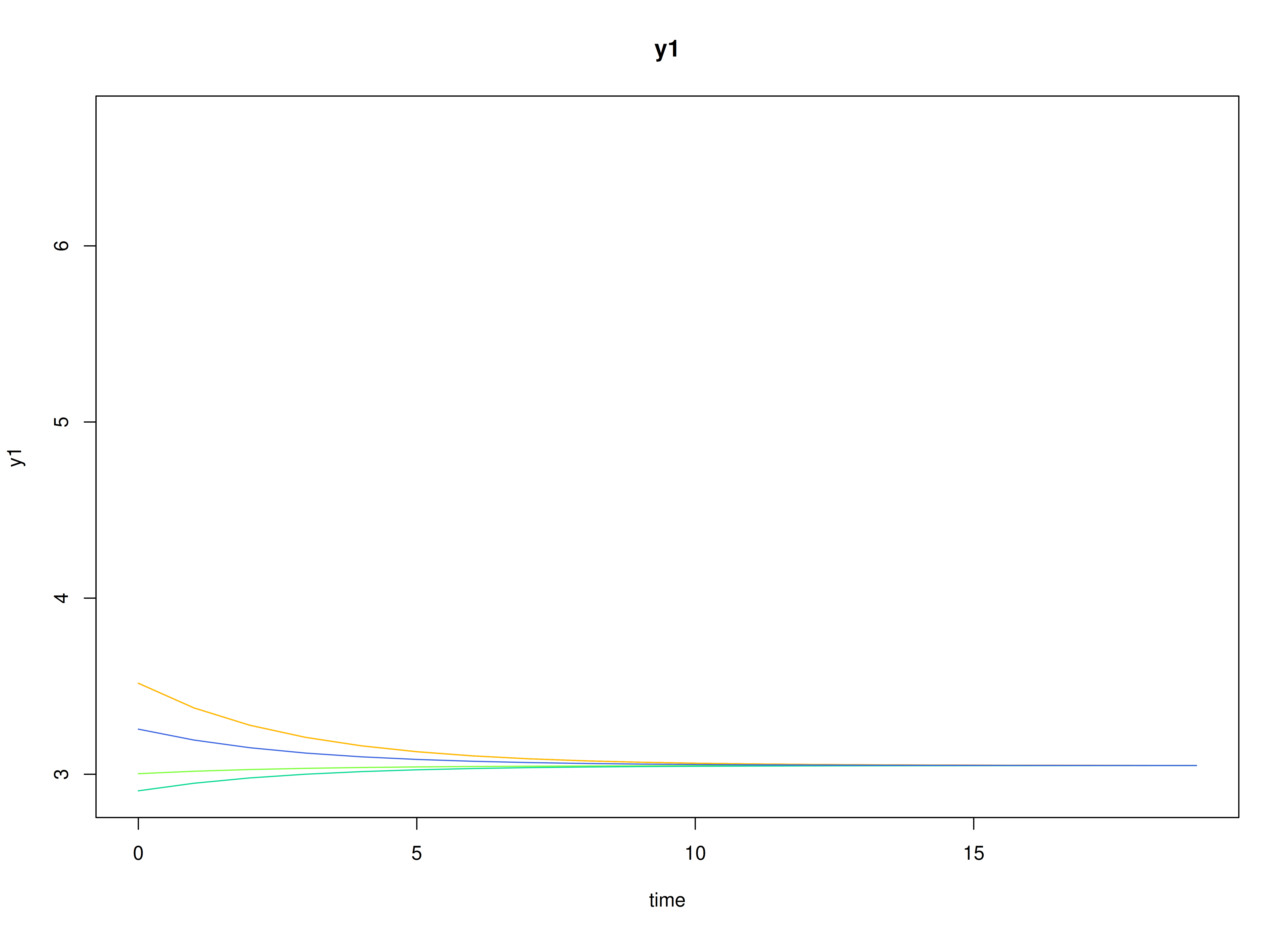
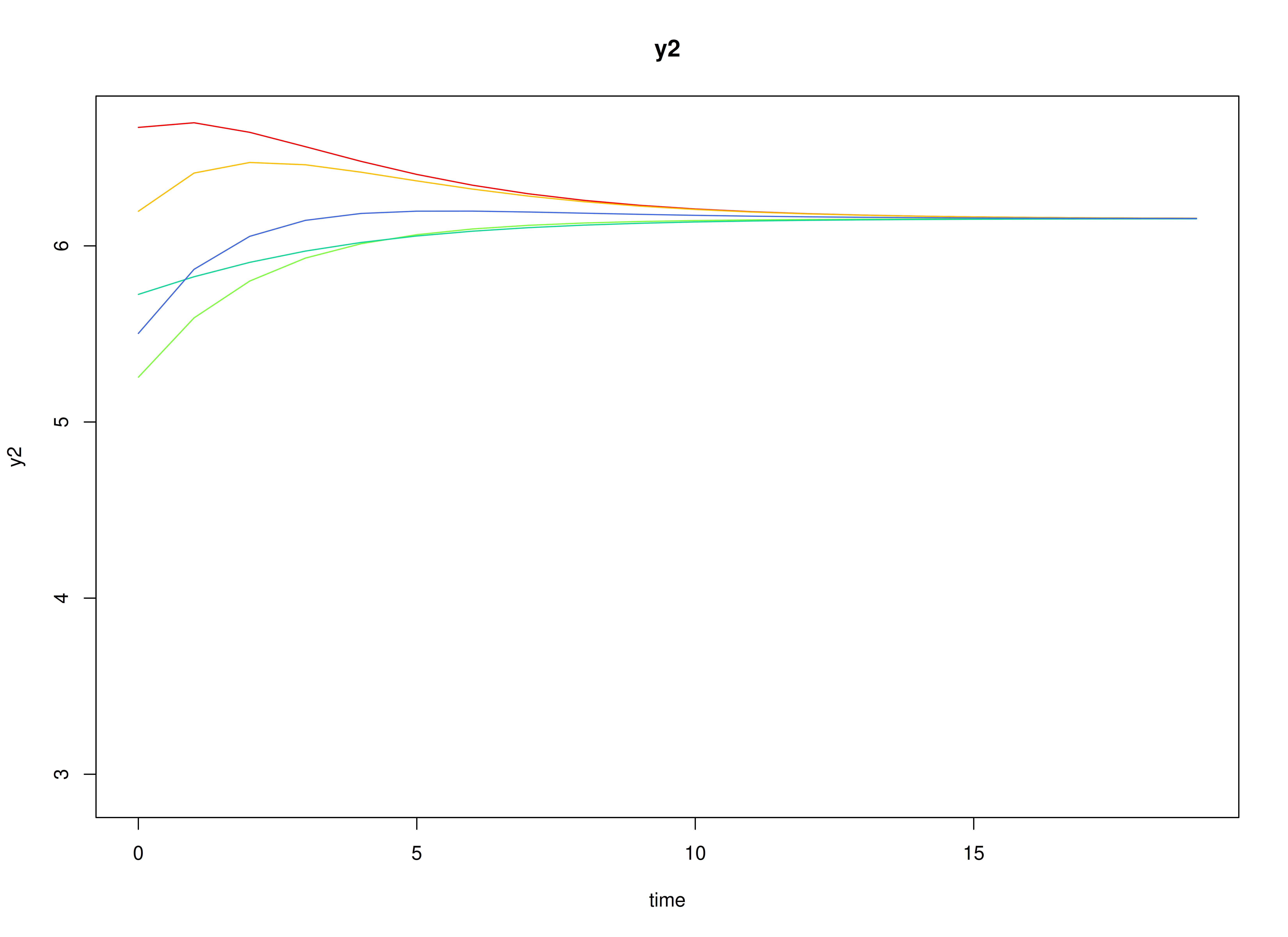
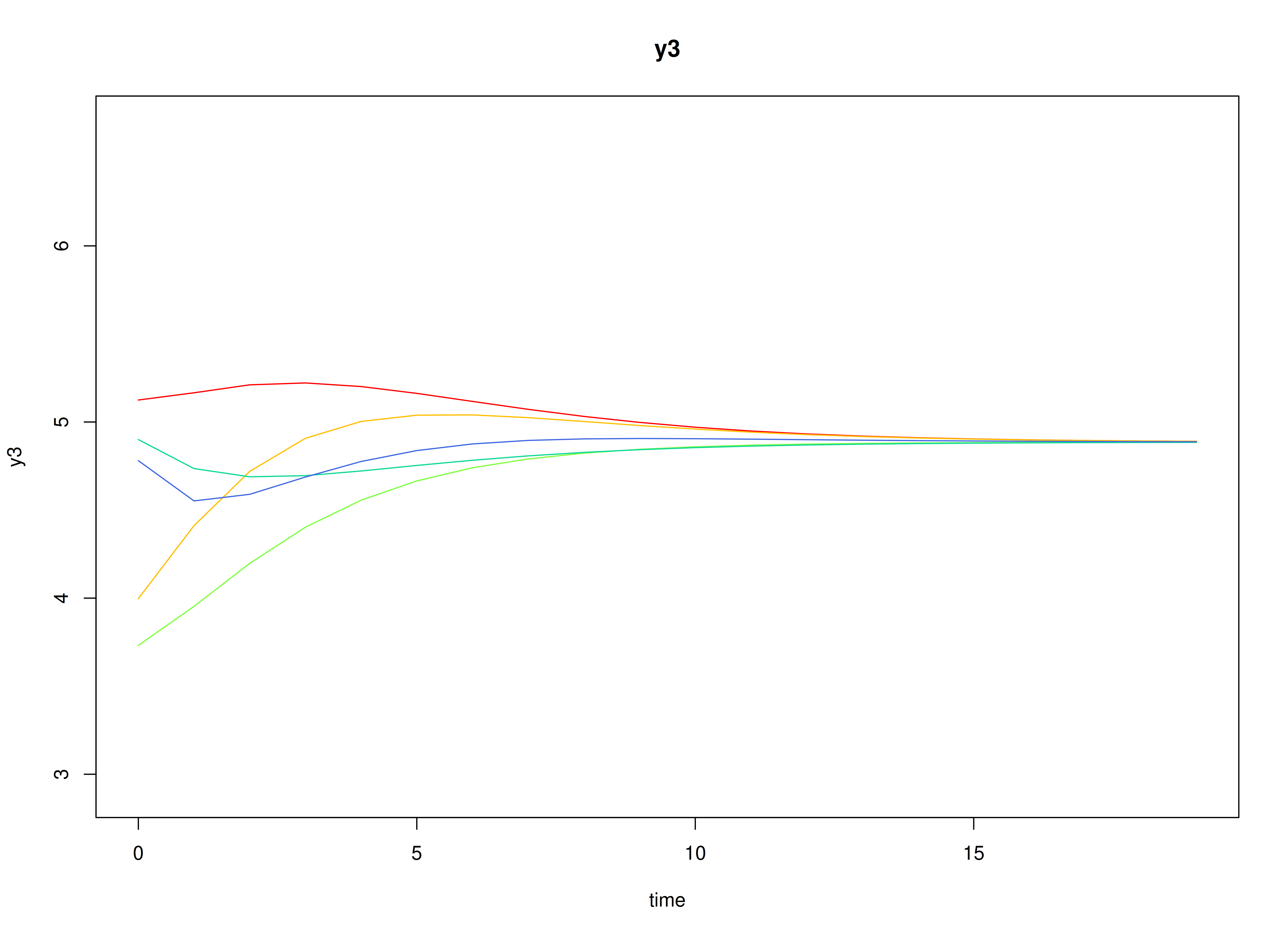
Using the SimSSMVARFixed Function from the
simStateSpace Package to Simulate Data
library(simStateSpace)
sim <- SimSSMVARFixed(
  n = n,
  time = time,
  mu0 = mu0,
  sigma0_l = sigma0_l,
  alpha = alpha,
  beta = beta,
  psi_l = psi_l
)
data <- as.data.frame(sim)
head(data)
#>   id time       y1       y2       y3
#> 1  1    0 3.375463 5.964917 3.883475
#> 2  1    1 3.136727 5.909374 3.866987
#> 3  1    2 3.215198 6.462812 3.995227
#> 4  1    3 3.427307 6.408953 4.408847
#> 5  1    4 3.108728 6.717274 5.303110
#> 6  1    5 3.885159 7.141896 5.024148
summary(data)
#>        id              time             y1              y2
#>  Min.   :  1.00   Min.   :  0.0   Min.   :1.169   Min.   :3.552
#>  1st Qu.: 25.75   1st Qu.:249.8   1st Qu.:2.755   1st Qu.:5.767
#>  Median : 50.50   Median :499.5   Median :3.054   Median :6.160
#>  Mean   : 50.50   Mean   :499.5   Mean   :3.055   Mean   :6.163
#>  3rd Qu.: 75.25   3rd Qu.:749.2   3rd Qu.:3.356   3rd Qu.:6.558
#>  Max.   :100.00   Max.   :999.0   Max.   :5.029   Max.   :8.619
#>        y3
#>  Min.   :2.460
#>  1st Qu.:4.544
#>  Median :4.893
#>  Mean   :4.895
#>  3rd Qu.:5.245
#>  Max.   :7.672
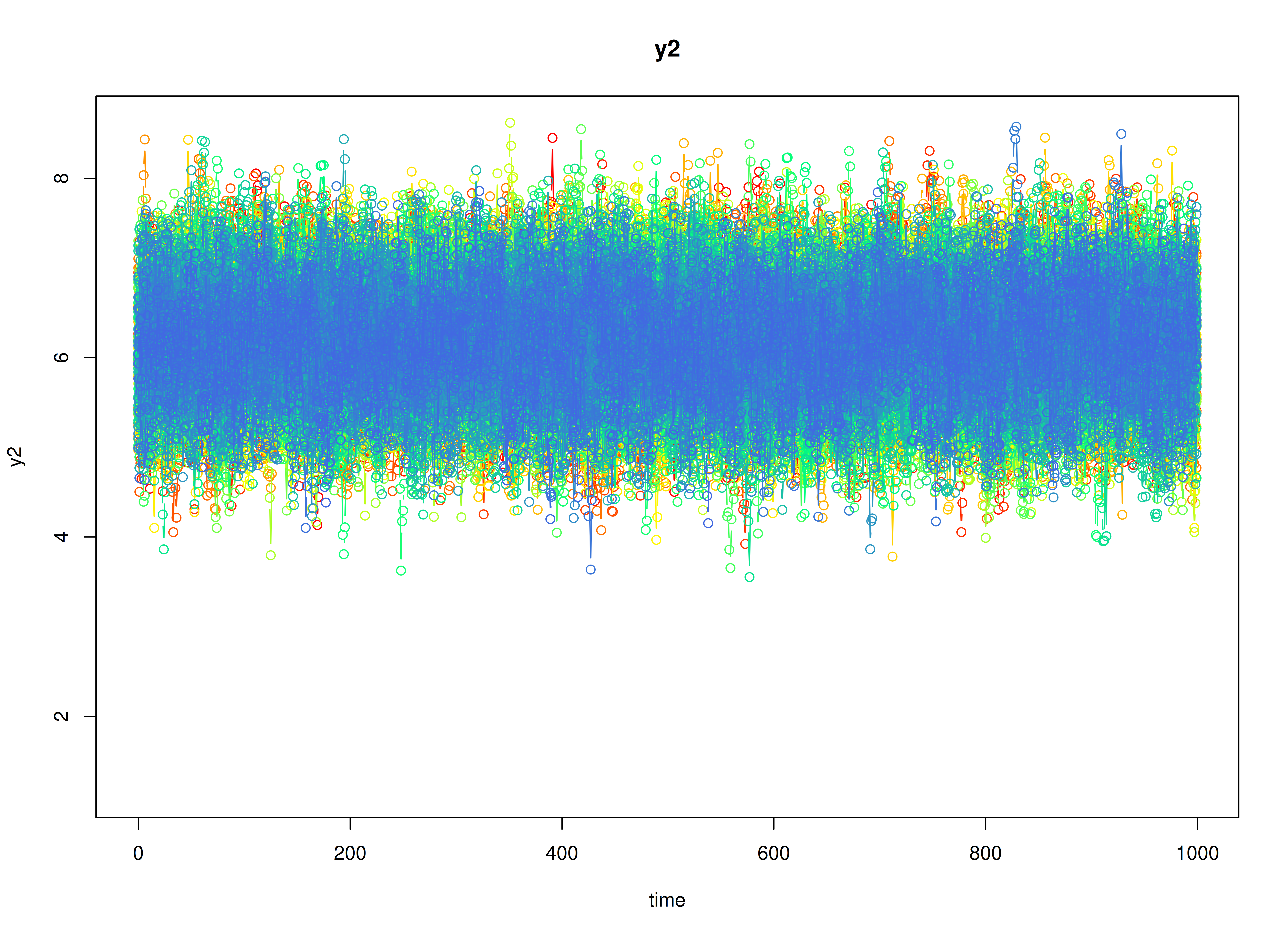
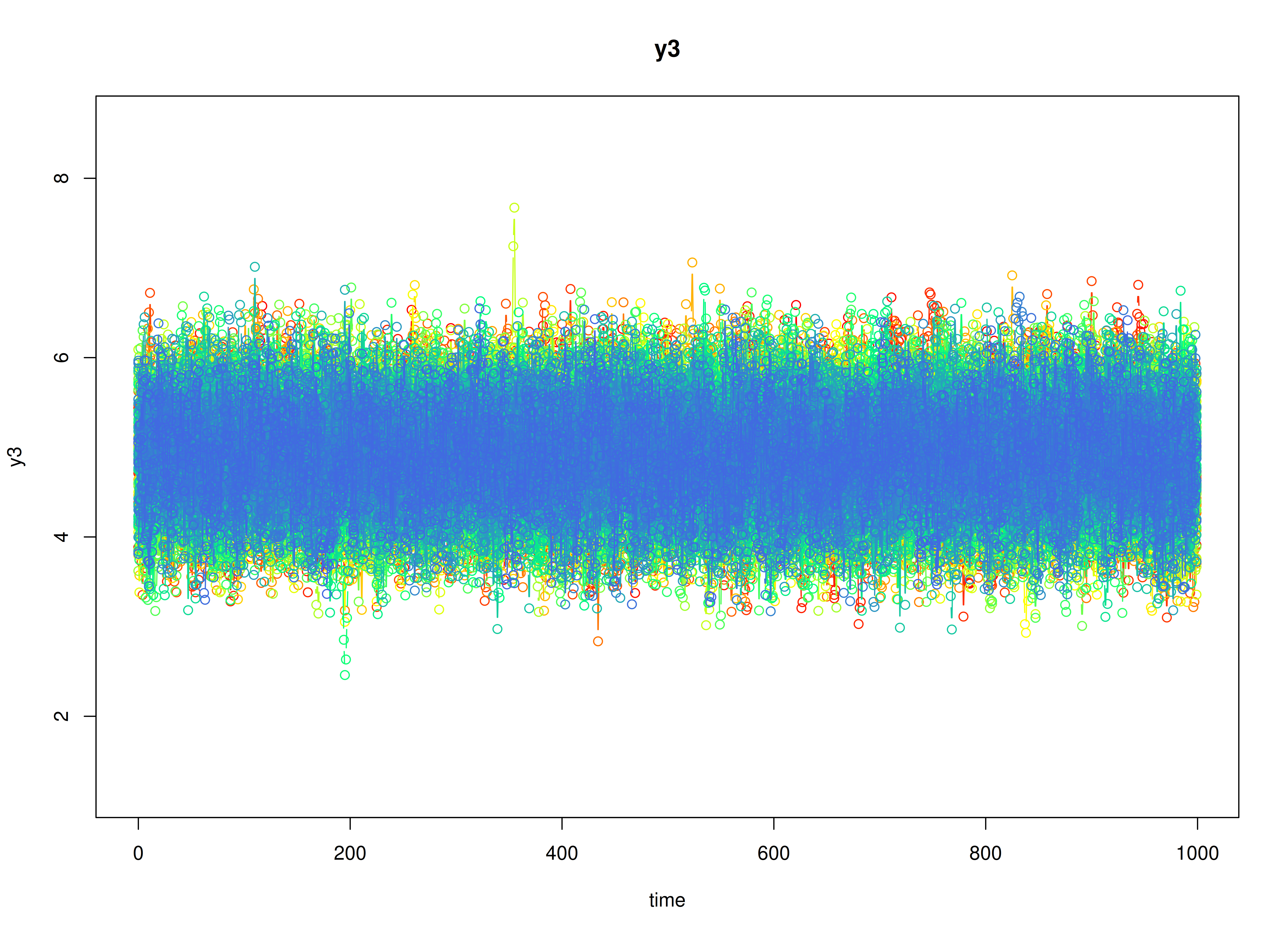
plot(sim)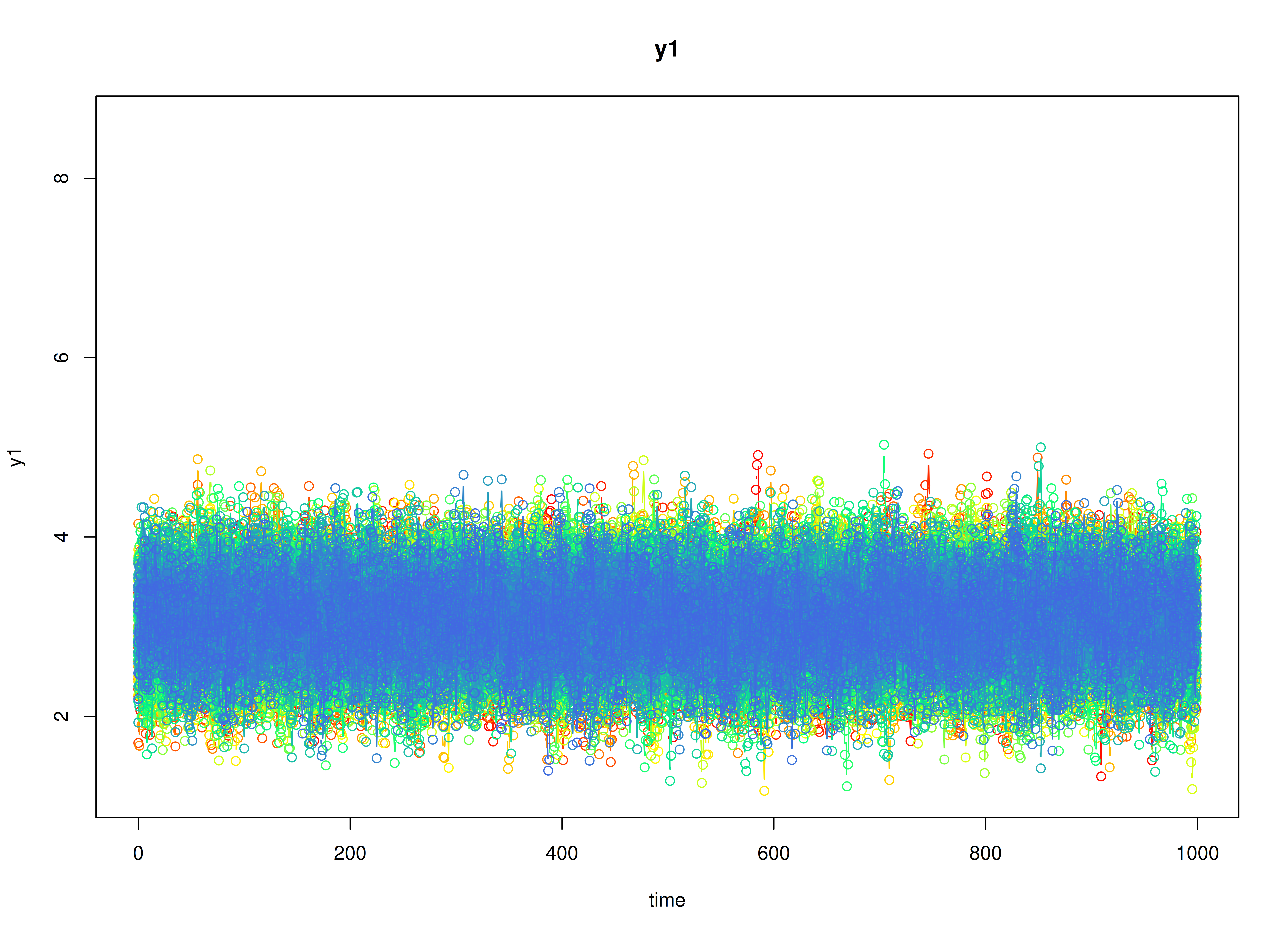
Model Fitting
The FitVARMxID function fits a DT-VAR model on each
individual
.
Note: Consider using the argument
ncoresto use multiple cores for parallel processing.
fit <- FitVARMxID(
  data = data,
  observed = c("y1", "y2", "y3"),
  id = "id",
  center = TRUE,
  ncores = parallel::detectCores()
)
Parameter estimates
summary(
  fit,
  means = TRUE,
  ncores = parallel::detectCores()
)
#> Call:
#> FitVARMxID(data = data, observed = c("y1", "y2", "y3"), id = "id",
#>     center = TRUE, ncores = parallel::detectCores())
#>
#> Convergence:
#> 100.0%
#>
#> Means of the estimated paramaters per individual.
#>   mu[1,1]   mu[2,1]   mu[3,1] beta[1,1] beta[2,1] beta[3,1] beta[1,2] beta[2,2]
#>    3.0548    6.1622    4.8943    0.7001    0.4990   -0.0991   -0.0022    0.5998
#> beta[3,2] beta[1,3] beta[2,3] beta[3,3]  psi[1,1]  psi[2,1]  psi[3,1]  psi[2,2]
#>    0.4038   -0.0051   -0.0022    0.4982    0.0997    0.0004   -0.0003    0.0990
#>  psi[3,2]  psi[3,3]
#>    0.0005    0.0994